


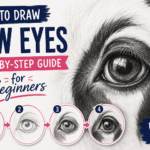


Every artist, from the Renaissance masters to modern digital illustrators, stands on the same foundation. If you’ve ever felt frustrated that your drawings look “flat” or inaccurate, the issue usually isn’t a lack of talent—it’s a lack of fundamental training.
Drawing is a language. Once you learn the alphabet—the fundamentals—you can draw anything you see. Here is how to master the building blocks of art.
1. Seeing Like an Artist: The Power of Observation
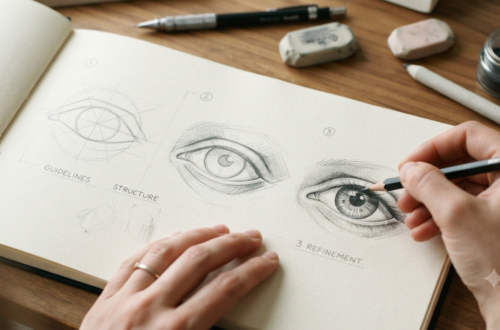
The most significant hurdle for beginners is drawing what they think they see rather than what is actually there. Our brains tend to simplify complex subjects into symbols (e.g., drawing a circle for an eye instead of observing the specific shape of the lid and iris).
How to train your eye:
- Slow down: Spend five minutes observing an object before making a single mark.
- Measure with your tool: Use your pencil to compare angles and proportions of your subject against your paper.
- Draw what you see, not what you know: If you are drawing a hand, focus on the shapes of the shadows and the negative space between fingers, rather than the “idea” of a hand.
2. Line, Shape, and Form: Building the Structure
These three elements are the skeleton of every drawing.
- Line: Lines aren’t just outlines. They carry energy and direction. Practice “mark-making” by varying your pressure. A confident, flowing line brings life to your work, while shaky, repetitive lines make a drawing feel unsure.
- Shape: Everything in the world can be broken down into basic geometric shapes: squares, circles, and triangles. If you can draw these shapes, you can draw any complex subject by “blocking in” the composition first.
- Form: This is what turns a flat shape into a 3D object. By understanding how light hits a sphere or a cube, you give your subjects weight and volume.
3. Value: The Language of Light and Shadow
If line and shape are the structure, value is the depth. Value refers to the lightness or darkness of an area. Without a range of values, your drawing will appear two-dimensional.
Key concepts to master:
- The Value Scale: Create a strip with five to seven boxes, ranging from pure white to deep black. Practicing this helps you see tonal differences more clearly.
- Light Sources: Identify where your light is coming from. This dictates where your highlights, midtones, core shadows, and cast shadows should be placed.
- Contrast: High contrast (placing dark values next to light ones) draws the viewer’s eye to a focal point. Use it sparingly to create drama and impact.
4. Perspective: Creating Depth in Space
Perspective is the mathematical framework that allows us to represent 3D space on a 2D surface. For beginners, start with the basics:
- 1-Point Perspective: Great for drawing objects from a head-on view (like a road disappearing into the distance).
- 2-Point Perspective: Essential for drawing corners of buildings or boxes.
Don’t rush into complex cityscapes. Practice drawing simple 3D boxes in perspective until the logic becomes second nature.
5. Composition and Negative Space
A great drawing is more than just a subject on a page; it is a well-composed scene.
- Negative Space: This is the area around and between your subject. Beginners often ignore it, but focusing on the negative space helps you get the proportions and placement of your positive subject correct.
- Balance: Use the “Rule of Thirds” or symmetry to create visual harmony. Ensure your focal point is placed in a way that guides the viewer’s eye across the page.
6. How to Practice Effectively
Consistency beats intensity. You will see more improvement drawing for 20 minutes every day than you will in one six-hour session once a week.
A Simple Practice Routine:
- Warm-up (5 mins): Practice drawing clean lines (straight, curved, and S-curves) and basic geometric shapes.
- Study (20 mins): Pick a simple object—like an apple or a coffee mug—and focus on just one fundamental, such as capturing the light and shadow values.
- Creative Sketch (15 mins): Draw whatever you enjoy. This keeps the process fun and prevents burnout.
Final Thoughts: Embrace the Process
The journey of learning to draw is full of “bad” sketches, and that is perfectly normal. Each mistake is a piece of data your brain uses to calibrate your hand-eye coordination for the next attempt. Treat your sketchbook as a laboratory, not a gallery.
By focusing on these fundamentals, you are moving away from guessing and toward understanding. Keep your pencil sharp, your observations keen, and your practice consistent. The breakthrough is closer than you think.
Tips for Continued Growth:
- Seek Feedback: Join online art communities to share your work.
- Reference Materials: Don’t draw from imagination until you have mastered drawing from life.
- Limit Your Tools: You don’t need expensive supplies. A basic graphite pencil and a sketchbook are enough to master every concept listed above.
Are you ready to start your first value study, or would you like a list of recommended exercises to practice each of these fundamentals in order?