








Have you ever stared up at a bright blue sky, stared at a blank white computer screen, or closed your eyes to rest, only to notice tiny black specs, squiggly lines, or cobwebs drifting across your field of vision? You blink hard, look away, and look back—yet they are still there, gliding lazily across your sight.
If this sounds familiar, you are not alone. Millions of people experience eye floaters every single day. While they are usually just a quirky, harmless byproduct of getting older, they can sometimes trigger sudden panic. Are they just annoying shadows, or are they a warning sign of a major medical emergency?
Let’s look at the science, symptoms, and truth behind eye floaters so you know exactly when to relax and when to call a doctor.
What Exactly Are Eye Floaters?
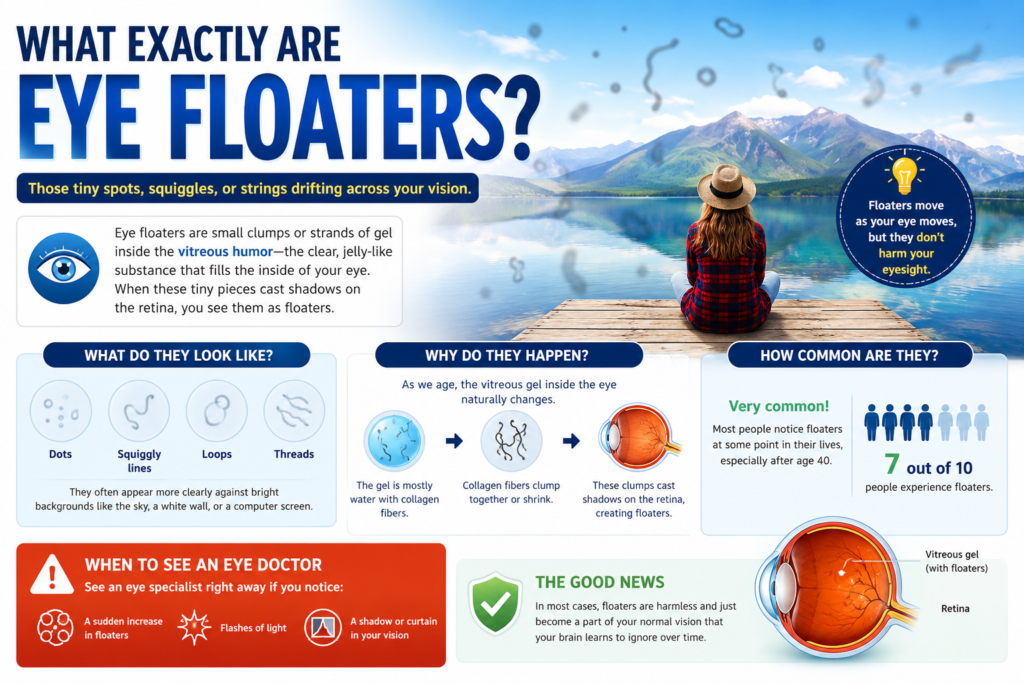
Despite how real they look, eye floaters are not outside objects sitting on the surface of your eye. You cannot wipe them away with a tissue, and blinking won’t make them vanish.
Cleveland Clinic
Instead, floaters exist inside your eyeball. To understand what they are, it helps to look at the internal anatomy of the eye:
Milan Eye Center
- The Vitreous Humor: The vast majority of your eye’s interior is filled with a clear, jelly-like substance called the vitreous. This gel helps your eye maintain its round, stable shape. Harvard University+ 1
- The Retina: Located at the very back of the eye, this is the light-sensitive tissue layer that acts like the sensor in a digital camera, capturing images and sending them to your brain. Harvard University
- The Illusion: What you perceive as a dark spot or string is actually a shadow. As microscopic clumps of protein or collagen fibers form within the vitreous gel, they block or refract light passing through your eye, casting tiny shadows onto your retina. Mayo Clinic
When you try to look directly at a floater, it seems to dart away. This happens because the floater is suspended in fluid; when your eye moves, the fluid shifts, causing the floater to drift along with your gaze.
Mayo Clinic+ 1
Common Triggers: Why Do They Form?
The vast majority of eye floaters develop naturally due to physical changes inside the eye. Understanding the root causes can help demystify why they suddenly appear.
Cleveland Clinic
1. The Aging Process (Natural Wear and Tear)
By far, the most frequent cause of floaters is age-related. As you transition through your 40s, 50s, and beyond, the gel-like vitreous begins to change. It slowly liquefies, shrinks, and becomes less uniform. Tiny collagen fibers inside the gel clump together, forming the strands and specs that cast shadows on your retina.
Cleveland Clinic+ 3
2. Posterior Vitreous Detachment (PVD)
As the vitreous gel continues to shrink, it can pull away from the interior wall of the retina. This milestone is called a Posterior Vitreous Detachment (PVD). While it sounds terrifying, PVD is a very common, natural part of aging and is usually harmless on its own.
Ross Eye Institute
3. Nearsightedness (Myopia)
People who are severely nearsighted are much more likely to develop floaters earlier in life. Because their eyeballs are often slightly longer in shape, the internal vitreous structure experiences different physical stresses, making the early breakdown of the gel more common.
Harvard University
4. Inflammation, Injury, or Bleeding
Less commonly, floaters can be caused by physical trauma to the face or eye, severe inflammation inside the eye (such as uveitis), or bleeding within the vitreous caused by conditions like diabetic retinopathy or high blood pressure.
Mayo Clinic
Red Flag Symptoms: When Are Floaters Dangerous?
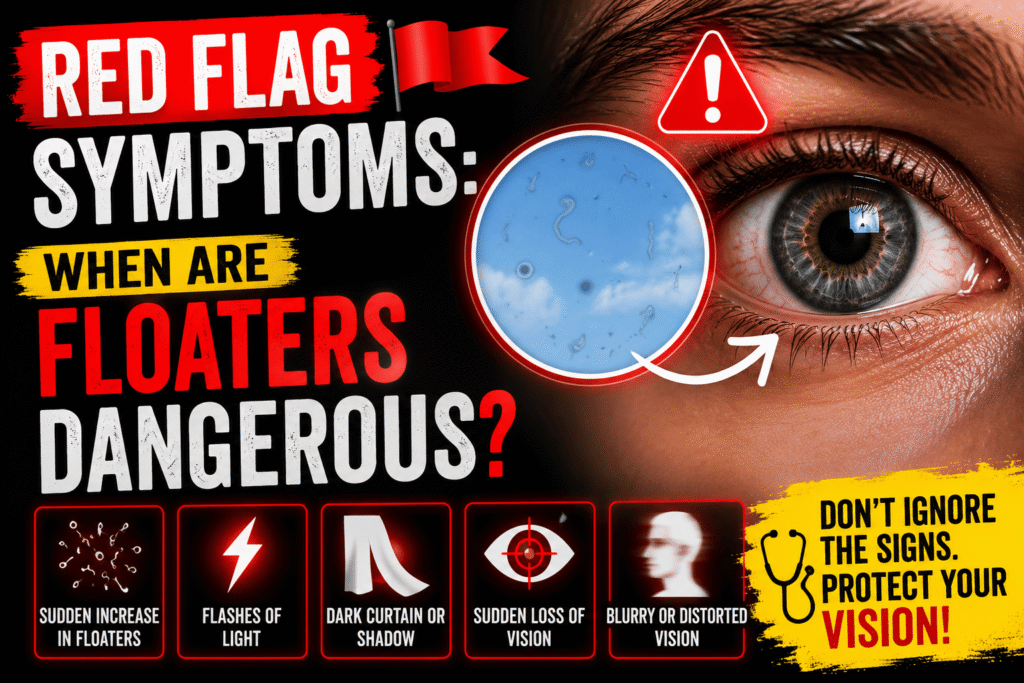
While most floaters are a benign annoyance, they can occasionally point to a sight-threatening medical emergency. When the shrinking vitreous gel pulls away from the retina, it doesn’t always detach smoothly. Sometimes, it tugs so hard that it tears the delicate retinal tissue. If fluid leaks behind the tear, it can cause a retinal detachment, which can lead to permanent vision loss if left untreated.
Mayo Clinic+ 3
Urgent Warning: You must seek immediate evaluation by an optometrist or ophthalmologist if you experience any of the following symptoms:
Mayo Clinic
- A sudden, explosive increase in the number of new floaters. Mayo Clinic
- Flashes of light (photopsia) in the same eye, looking like camera strobes or lightning streaks in your peripheral vision. Cleveland Clinic
- A dark shadow, curtain, or blurry area creeping across your side or upper/lower field of vision.
- A sudden, unexplained drop in your overall vision clarity.
How Are Eye Floaters Handled or Treated?

If your floaters are caused by normal aging or a stable PVD, doctors generally recommend patience and observation. Over time, your brain adapts through a process called habituation, effectively learning to ignore the shadows. Additionally, gravity often causes floaters to slowly sink downward, drifting out of your direct line of sight.
Cleveland Clinic+ 1
For severe cases where floaters heavily obstruct vision and ruin quality of life, medical interventions do exist, though they carry risks:
- Vitrectomy: A surgical procedure where an ophthalmologist removes the vitreous gel containing the floaters and replaces it with a clear saline solution. Because of risks like infection, bleeding, and cataracts, this is rarely performed strictly for minor, age-related floaters. Cleveland Clinic
- Laser Vitreolysis: A specialized laser is used to break up larger floater clumps into smaller, less noticeable pieces. This procedure is less invasive than surgery, but it is still debated within the medical community regarding its long-term safety and overall efficacy. Harvard Health
Final Thoughts and Next Steps
Seeing a stray black spot or thread dancing across your vision is usually just a harmless reminder that your eyes are aging gracefully. However, because a sudden storm of floaters can signal a torn or detached retina, it is critical never to brush off rapid, dramatic changes to your sight. If you have lived with stable floaters for years, there is likely nothing to fear—but if they arrive overnight alongside flashes of light, schedule an emergency eye exam immediately to protect your long-term vision.
Cleveland Clinic+ 2
Have you recently noticed an increase in eye floaters, or are you experiencing any accompanying flashes of light?