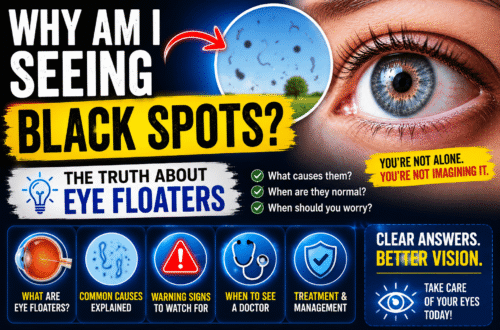







Have you ever looked up at a bright blue sky or stared at a white computer screen and noticed tiny specks, threads, or cobwebs drifting across your field of vision? When you try to look directly at them, they seem to dart away. These mysterious spots are commonly known as eye floaters.
For most people, seeing black spots is a harmless, albeit occasionally annoying, part of the natural aging process of the eye. However, in some cases, sudden changes in your vision can indicate a serious underlying medical condition that requires immediate attention from an eye care professional.
Understanding what causes these spots, when they are normal, and when they signal an emergency is vital for protecting your long-term eye health. This comprehensive guide explores everything you need to know about eye floaters, flashes, and maintaining clear vision.
What Are Eye Floaters?
To understand why you might be seeing black spots, it helps to understand the basic anatomy of the eye. The interior of your eye is filled with a gel-like substance called the vitreous humor, or simply the vitreous. This gel helps the eye maintain its round shape and allows light to pass unobstructed through the lens to the retina at the back of the eye.
The vitreous is composed primarily of water, collagen fibers, and hyaluronic acid. When we are born and throughout our youth, this gel has a smooth, uniform consistency. However, as we age, the collagen fibers within the vitreous begin to clump together or break down.
When these tiny clumps or strands form, they cast shadows onto the retina—the light-sensitive tissue lining the back of your eye. What you perceive as black spots, floating threads, wiggly lines, or cobwebs are actually the shadows of these microscopic debris particles drifting inside your eye.
Common Causes of Seeing Black Spots
While normal aging is the most frequent culprit behind seeing black spots, several other factors and medical conditions can cause or contribute to floaters.
1. Posterior Vitreous Detachment (PVD)
As you age (typically starting around age 50 or 60), the vitreous gel naturally shrinks and liquefies. Eventually, the gel can pull away from the inner surface of the retina. This is known as a posterior vitreous detachment (PVD).
PVD is a very common, generally harmless condition that often triggers a sudden increase in floaters and occasional brief flashes of light. While PVD itself does not cause permanent vision loss, the separation process can occasionally cause a tear in the retina.
2. Retinal Tear or Detachment
If the shrinking vitreous pulls too hard on the retina, it can tear the tissue. When a retinal tear occurs, fluid can pass through the tear and lift the retina away from the back wall of the eye, resulting in a retinal detachment.
This is a medical emergency. Symptoms of a retinal detachment often include:
- A sudden, dramatic increase in the number of floaters.
- Flashes of light in the affected eye.
- A dark shadow or “curtain” sweeping across your peripheral or central field of vision.
Without prompt surgical intervention, a retinal detachment can lead to permanent vision loss or blindness.
3. Eye Bleeding (Vitreous Hemorrhage)
Blood and other cellular fluids can leak into the vitreous gel, casting dense shadows that appear as dark spots or a reddish haze. Vitreous hemorrhage can be triggered by:
- Diabetic retinopathy (damaged blood vessels in the eye caused by diabetes).
- High blood pressure (hypertension).
- Blocked blood vessels in the retina (retinal vein occlusion).
- Physical trauma or injury to the eye.
4. Intraocular Inflammation (Uveitis)
Uveitis is a form of eye inflammation that affects the middle layer of tissue in the eye wall (the uvea). Conditions causing inflammation can release inflammatory cells and debris into the vitreous gel, creating noticeable floaters and blurred vision, often accompanied by eye pain and redness.
5. Eye Medications and Surgeries
Certain medications injected into the eye or complications from eye surgeries (such as cataract surgery) can introduce air bubbles, silicone oil droplets, or cellular debris into the vitreous cavity, resulting in temporary or permanent floaters.
Symptoms: What Do Floaters Look Like?
When people talk about seeing black spots, they are usually describing a variety of visual phenomena. Floaters can manifest in several different shapes and forms:
- Little black or gray dots: Small, distinct specks that drift slowly as you move your eyes.
- Squiggly lines or threads: Thin, thread-like structures that resemble microscopic worms or hairs.
- Cobwebs: Interconnected strands that drift across your entire field of vision.
- Rings or circles: Circular shapes that can be faint or dark.
Because floaters float inside the fluid of the vitreous gel, they do not remain stationary. When you try to look directly at them, they dart away because your eye movement shifts the fluid and the suspended particles within it. They are often most noticeable when looking at a plain, brightly lit background, such as a blue sky, a white wall, or a computer screen.
Are Floaters Dangerous?
In the vast majority of cases, eye floaters are entirely benign. They are a normal byproduct of aging, and over time, many people find that their brain adapts to them, effectively filtering them out so they are no longer consciously noticed.
However, because a sudden shower of floaters can also be the first warning sign of a torn or detached retina, it is critical to know when to seek professional medical evaluation.
Red Flag Symptoms: When to See a Doctor Immediately
You should schedule an urgent appointment with an optometrist or ophthalmologist immediately if you experience any of the following “red flag” symptoms:
- A sudden, dramatic increase in the number of new floaters, spots, or cobwebs.
- Flashing lights (photopsia) in the eye experiencing the floaters. These often look like lightning streaks, camera flashes, or flickering lights, especially in dim lighting.
- A dark shadow, curtain, or gray blur moving across any part of your peripheral or central vision.
- Sudden blurred vision accompanying the floaters.
- Eye pain combined with vision disturbances.
If you notice these symptoms, do not wait to see if they resolve on their own. Immediate diagnosis and treatment can prevent irreversible damage to your vision.
Diagnosis: What Happens During an Eye Exam?
If you visit an eye doctor because you are seeing black spots, they will perform a comprehensive dilated eye examination to determine the cause.
- Visual Acuity Test: Measures how clearly you can see at various distances.
- Pupil Dilation: The doctor will instill specialized eye drops to widen your pupils. This allows light to enter freely so the physician can obtain a wide, detailed view of the internal structures of your eye, including the vitreous and the entire retina.
- Slit-Lamp Examination: A specialized microscope with a bright light source used to examine the front and interior of the eye in high magnification.
- Indirect Ophthalmoscopy: Using a head-mounted light and a specialized lens, the doctor examines the retina and vitreous in three dimensions, pressing gently on the outside of the eyelid if necessary to view the very edges of the retina.
- Optical Coherence Tomography (OCT): A non-invasive imaging test that uses light waves to take cross-section pictures of your retina, mapping its thickness and identifying microscopic tears or swelling.
Management and Treatment Options
Treatment for seeing black spots depends entirely on the underlying cause and how severely the floaters impact your daily life.
1. Observation and Reassurance
If your floaters are caused by normal aging, posterior vitreous detachment (PVD), and are not threatening your retina, your eye doctor will likely recommend leaving them alone. Over weeks and months, gravity often pulls floaters down out of your direct line of sight, or your brain naturally learns to ignore them.
2. Laser Vitreolysis
For patients whose floaters are severe, persistent, and significantly impairing their vision or quality of life, a specialized procedure called laser vitreolysis may be considered.
- During this outpatient procedure, an ophthalmologist uses a specialized medical laser to target and vaporize the large collagen clumps in the vitreous, breaking them down into smaller, less noticeable pieces.
- While non-invasive, laser vitreolysis is not suitable for all types of floaters and carries potential risks, so it is performed selectively.
3. Vitrectomy Surgery
In extreme cases where floaters are exceptionally dense and debilitating, or when they are accompanied by a retinal detachment or vitreous hemorrhage, a surgical procedure called a vitrectomy may be performed.
- During a vitrectomy, the surgeon makes tiny incisions in the eye, removes the gel-like vitreous containing the floaters, and replaces it with a sterile saline solution or gas bubble that the body eventually absorbs and replaces with its own natural fluids.
- Because vitrectomy carries significant risks—including cataracts, infection, and retinal detachment—it is generally reserved for severe cases where vision is severely compromised.
Home Remedies and Lifestyle Support
While you cannot completely prevent the natural aging changes that cause standard eye floaters, you can support overall eye health through smart lifestyle choices:
- Protect Your Eyes from Injury: Always wear protective eyewear when playing sports, doing construction work, or handling chemicals to reduce the risk of traumatic eye injuries that can trigger retinal detachment or internal bleeding.
- Manage Chronic Conditions: Keep blood pressure and blood sugar levels well-controlled if you have hypertension or diabetes. This minimizes the risk of diabetic retinopathy and vascular blockages that cause vitreous hemorrhages.
- Eat a Nutrient-Rich Diet: Consume plenty of leafy greens (spinach, kale), colorful vegetables, and omega-3 fatty acids (found in fish like salmon), which support overall ocular health and cellular function.
- Stay Hydrated: Dehydration can sometimes affect the balance of fluids within the body, including the eye. Drinking adequate water daily supports overall cellular health.
- Schedule Regular Eye Exams: Comprehensive dilated eye exams are essential, especially as you age, to catch silent eye diseases and early retinal tears before they lead to severe vision loss.
Conclusion
Experiencing floaters and seeing black spots is a common phenomenon that most people encounter at some point in their lives. While they are usually harmless remnants of aging vitreous gel, they should never be completely ignored—especially if they appear suddenly, are accompanied by flashes of light, or obstruct your visual field.
By staying vigilant, understanding your body’s signals, and seeking prompt professional care when warning signs arise, you can protect your precious vision and ensure your eyes remain healthy for years to come. If you have recently noticed an increase in spots or flashes, schedule an appointment with your eye care specialist today for peace of mind and professional guidance.